EV review · BMW iX1
BMW iX1 Review — Premium Electric SUV for Indian City Life
By CarsWhere Editorial
BMW iX1 Review — Premium Electric SUV for Indian City Life
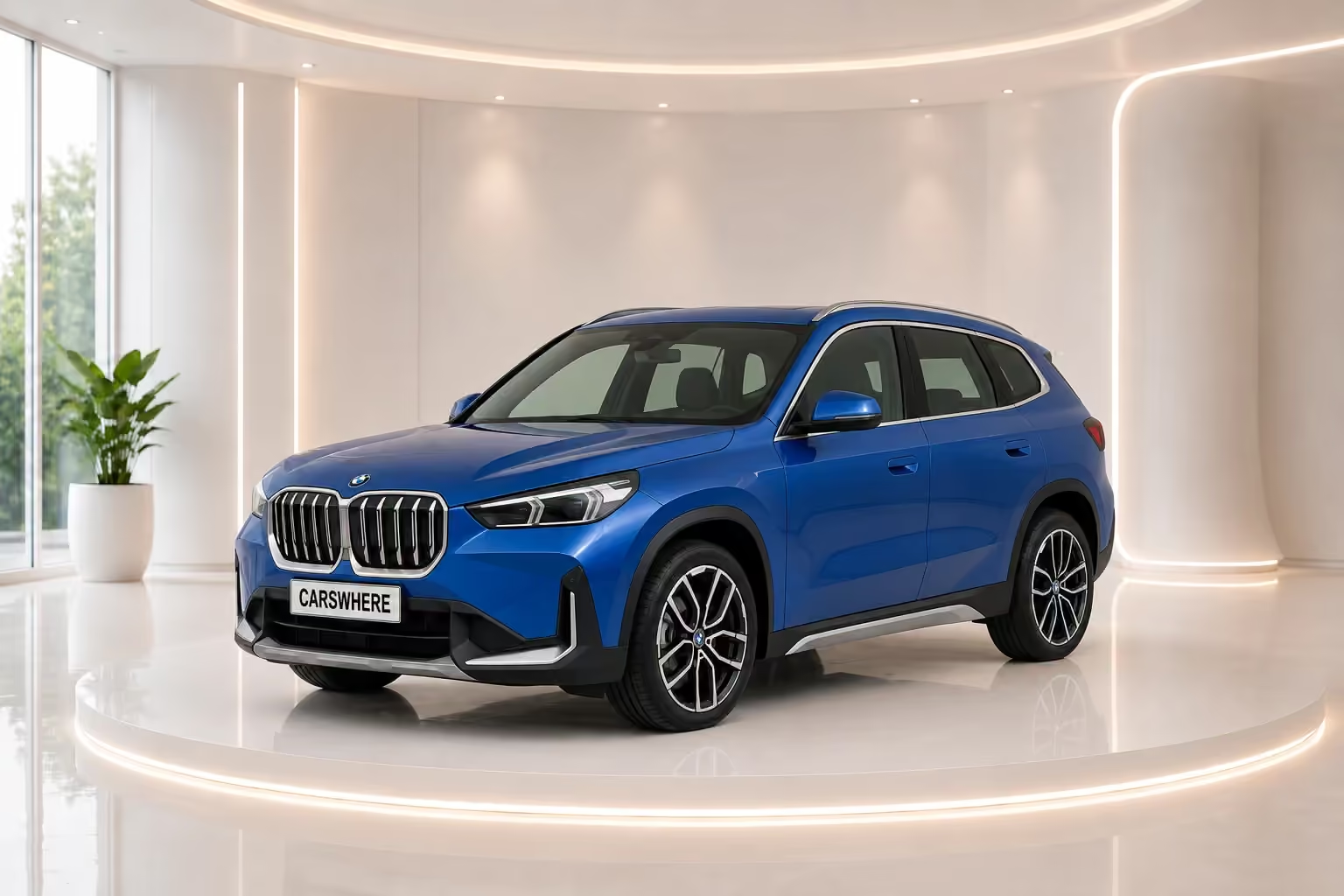
OVERVIEW The BMW iX1 is a premium electric SUV considered here for Indian buyers using CarsWhere catalogue specifications and market positioning. This is an editorial assessment, not a claim of a first-hand road test. its compact-luxury format prioritises urban usability over the scale of a full-size premium EV. The current catalogue places the range at ₹66.90 Lakh to ₹66.90 Lakh ex-showroom across the catalogue-listed range. Buyers should use the live variant page for the latest exact price and equipment because trim availability can change. WHO IS THIS CAR FOR? Best for: premium urban buyers with private charging and predictable travel patterns. It deserves consideration when daily travel includes crowded junctions, narrow residential lanes, uneven surfaces and occasional highway use. The right answer still depends on parking space, annual running, passenger count and local dealer access. A buyer travelling mainly within a city may value ease of placement and an automatic gearbox differently from someone covering long inter-city distances every month. DESIGN AND ROAD PRESENCE The iX1 should be judged as a working family vehicle rather than only by showroom styling. In India, exterior size affects whether a car fits an apartment parking bay, clears a tight ramp and remains easy to position beside two-wheelers and auto-rickshaws. The premium electric SUV proportions give it a distinct role in this shortlist. Buyers should inspect outward visibility, the view of the bonnet, mirror coverage and the ease of judging each corner. Wheel and tyre choices also matter because a visually attractive large wheel can bring a shorter tyre sidewall, which may be less forgiving over sharp potholes. INTERIOR, QUALITY AND EVERYDAY ERGONOMICS Cabin evaluation should begin with driving position, seat adjustment, pedal alignment and simple access to frequently used controls. Touchscreens are useful, but Indian traffic makes physical access to demisting, climate control and common shortcuts valuable. The quality question is not only about soft materials: durable switchgear, practical storage, easy-clean surfaces and a secure place for phones and toll receipts can matter more over years of use. Families should check whether rear doors open widely enough for children or older passengers and whether the floor height makes entry comfortable. SPACE AND COMFORT Seat comfort needs a household-specific check. Front-seat occupants should set their normal position before rear legroom and knee room are judged. Three-abreast use should be tested with the actual family because shoulder room, seat contour and the centre tunnel can change the experience. Rear AC effectiveness is especially important in hot Indian summers, while window area and headroom influence comfort on long trips. If this vehicle has more than two rows, buyers should examine access, foot room and luggage capacity with every seat raised rather than assuming the final row will suit adults. FEATURES AND TECHNOLOGY The useful features are those that reduce effort every day: a clear reversing camera, parking sensors, effective automatic climate control, phone connectivity, charging points and good headlamps. Equipment varies by variant, so the longest feature list is not automatically the best value. ADAS, where a selected trim provides it, should remain driver assistance rather than a substitute for attention. Lane markings, motorcycles filtering through traffic, temporary diversions and inconsistent road edges can limit how smoothly assistance systems operate on Indian roads. ENGINE OR MOTOR AND PERFORMANCE CarsWhere currently lists electric choices for the iX1. No acceleration, braking or measured-efficiency claim is made here. The useful buying question is whether the selected powertrain suits stop-start traffic, regular gradients, passenger loads and highway overtaking. Buyers with low annual running may prefer simplicity, while high-mileage users may place more weight on efficiency and fuel availability. Electric buyers should compare battery and range information on the exact variant page and plan around charging access rather than treating a certification figure as guaranteed real-world distance. TRANSMISSION Catalogue-listed transmission choices include automatic. In dense traffic, an automatic can reduce workload, but its behaviour at parking speed and during quick gap selection should be assessed personally. Manual buyers should check clutch weight and low-speed tractability. The gearbox must also be paired with the correct engine or motor variant; a familiar model name does not mean every transmission is offered with every powertrain. CarsWhere links this review to the model so the current variant specifications remain the authoritative reference. RIDE, HANDLING AND INDIAN ROAD CONDITIONS Ride comfort depends on speed, load, wheel size and road surface, so this editorial review avoids unsupported road-test claims. A useful showroom and test-drive checklist includes broken tarmac, expansion joints, a tall speed breaker and a rough low-speed patch. Listen for sharp impacts and note how quickly the body settles. Steering effort matters during parking, while stability and predictable responses matter on faster roads. Ground clearance should be considered together with wheelbase and passenger load rather than as a single number. CITY DRIVING For city use, visibility, turning space and smooth low-speed control are central. its compact-luxury format prioritises urban usability over the scale of a full-size premium EV. Parking cameras and sensors help, but buyers should still confirm that the vehicle fits their regular garage or basement ramp. Fuel economy or energy use will vary with congestion, air-conditioning, route and driving style; CarsWhere therefore does not invent a measured city figure. The most suitable variant is often the one that makes frequent driving easier without adding features that the household will rarely use. HIGHWAY DRIVING Highway suitability includes more than engine output. Seat support, cabin noise, headlamp performance, straight-line confidence and overtaking reserves all affect fatigue. Families should check luggage space with the passenger configuration they actually use. A full load changes performance and ride, so a short solo demonstration cannot answer every touring question. For an EV, the route's dependable charging points and contingency options matter; for petrol, diesel, hybrid or CNG, tank range and fuel availability shape planning differently. EFFICIENCY, RANGE AND RUNNING CONTEXT Official efficiency or range data should be read as a comparison reference, not a promise. Traffic density, temperature, tyre pressure, payload and driving speed create substantial variation. CNG users should consider station queues and boot packaging. Hybrid buyers should understand that the system's advantage depends on route and driving pattern. EV buyers benefit most when routine charging is predictable at home or work. Service access, consumable prices, insurance and resale expectations should be checked locally because they are not identical across India. SAFETY Buyers should compare the exact variant's listed airbags, stability assistance, braking equipment, tyre specification and driver-assistance features. CarsWhere does not make an unsupported crash-performance claim. Safe ownership also includes correctly adjusted head restraints, child-seat compatibility, good tyres and disciplined use of seat belts in every row. A feature being present does not remove the need to understand how and when it operates. PRACTICALITY AND OWNERSHIP CONSIDERATIONS Practicality is where a shortlist becomes personal. Carry the usual stroller, suitcases or work bags when examining the boot. Check the spare-wheel arrangement where relevant, rear-seat folding, door-pocket size and charging-port or fuel-filler access. Dealer and service reach should be verified for the buyer's city and regular travel corridor. Resale strength can change with powertrain demand and local preference, so it should not be treated as guaranteed. The iX1 makes the most sense when its packaging and support network align with the household's actual routine. WHAT WE LIKE • Premium compact-SUV packaging • Electric urban suitability • Manageable footprint for the class WHAT COULD BE BETTER • Value depends on access to dependable charging • Long inter-city trips require planning VARIANT AND BUYING CONSIDERATIONS Start with the required powertrain and transmission, then add safety and daily-use equipment before cosmetic extras. Compare the price jump between adjacent variants against features the family will use. The live CarsWhere catalogue is the source for current specifications and ₹66.90 Lakh to ₹66.90 Lakh ex-showroom across the catalogue-listed range. Buyers considering the iX1 may also look at Creta Electric, BE 6 FE, XUV 3XO EV. Those alternatives should be compared by equivalent powertrain and equipment, not only by headline starting price. VERDICT The BMW iX1 is best understood through its intended use: premium urban buyers with private charging and predictable travel patterns. Its strengths are relevant to Indian conditions, but the limitations deserve the same weight. This CarsWhere Editorial review deliberately avoids claims about measured performance, long-term reliability or real-world efficiency that are not established in the catalogue. Shortlist the appropriate variant, inspect space with the usual passengers and luggage, and take a representative local test drive before deciding.
Explore the full BMW iX1 lineup with detailed specifications and pricing.
View Variants & Pricing →